


Hatchery Starter
For a hatchery that sells to a few farms
a month, about $15
- Up to 100,000 fish counted a month
- Count certificates
- 2 users
Product
Who it's for
Company
Fingerling counting for hatcheries
Film a basin with your phone. Fincount gives the count, the sizes and a certificate your buyer can check.
Built for African catfish hatcheries. Works offline on an Android phone. Every count comes with a range.
Book a demoThe problem
Every fingerling is counted before it leaves the hatchery. Today that count is a person with a bowl, or a weighed sample divided by a guess.
“I counted 5,000. The buyer counted again and says it is short.”
Fingerlings are counted by hand, or by weighing a small sample and dividing. The errors carry through to harvest, where farmers often find fewer fish than they expected.
lost on a 5% miscount of 100,000 juveniles sold at ₦50 to ₦80 each
Source: Southern Regional Aquaculture Center, publication 395, AgricBusiness market survey
“By the third week the big ones had eaten half of the small ones.”
In a study of African catfish fry, survival after four weeks was 1.2% with no sorting and 49.17% when the fry were sorted by size every three days. You can only sort what you can measure.
survival after four weeks, no sorting against sorting every three days
“We feed by guess, and feed is where the money goes.”
Feed is estimated at 60% to 70% of what it costs to grow fish. Feeding by the real weight of the fish in a pond, not by a guess, saves money on every bag.
The market
of fish Nigeria needs each year, with a gap of more than 2.2 million tonnes
farmed each year, the most in sub-Saharan Africa
Source: Gazette, citing WorldFish
of farmed fish in Nigeria are catfish and their hybrids
Source: Hatchery International
The workspace
This is the real workspace with test basins from the Fincount simulator. Click through the counts, a sale and a pond. Nothing here can be changed.
Read only tour. Test basins from the Fincount simulator.
Open the full tourTest hatchery
Loading the tour workspace.
Counts
1 in this tour
Walkthrough basin
One frame of the video
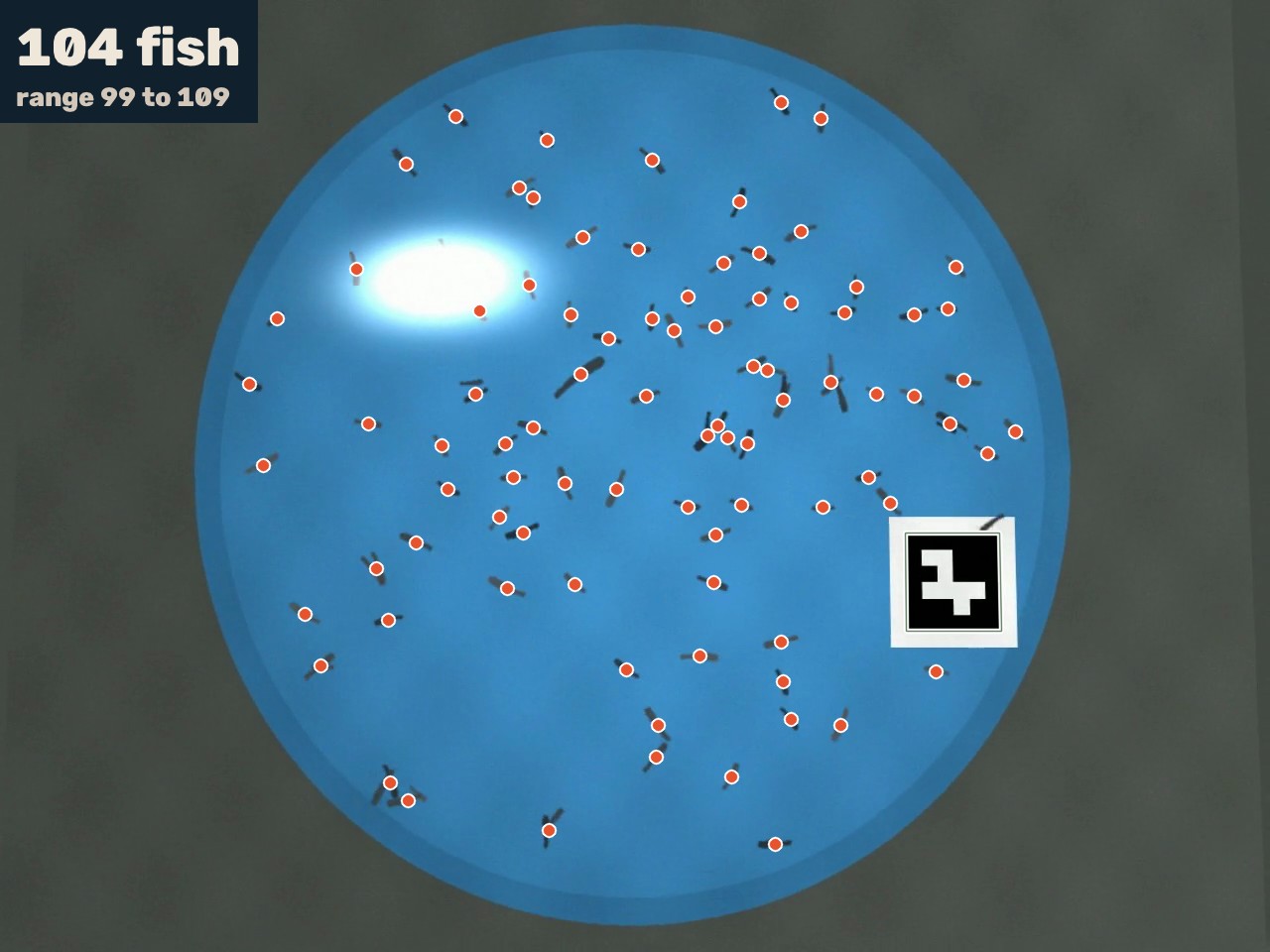
Stock count, 3 to 5 cm
Final0fish
Range 99 to 109
Model trained on test basins
How it works
Three steps, one phone. Each step shows what you see on the screen.
One count, start to report
Seconds from the start of filming
10 seconds, phone on its stand about 50 cm above the basin.
First count on the phone, offline. Design target: under 10 seconds.
About 3 MB for 10 seconds of video, sent when the phone has signal. It can start later than drawn.
A stronger version of Fincount AI recounts on AWS. Design target: under 2 minutes. The one run we walk through took the engine 4.4 seconds.
Ready when the cloud check ends. Your buyer can scan it and check the count.
The filming rule
Design target
Waits for signal
Report ready
The bars show the order of one count and our design targets, not field timings. The 10 second film is the filming rule; the under 10 second phone count and the under 2 minute cloud check are the targets we are building to.
01Step 1
Pour the fingerlings into a light basin with a little water, put the printed scale card on the floor and hold the phone above it. The Capture Guide checks the picture live and unlocks the record button only when it is good.
02Step 2
The phone gives a first count straight away. When the video uploads, a stronger check recounts every basin and gives the final count, the size spread and an estimated weight, each as a range.
03Step 3
Basins add up into one sale. Fincount signs the sale and gives your buyer a link and a QR code. The buyer scans it, sees the count as you issued it, and can recount on arrival with the same app.
Fincount AI
Every feature has the AI doing the hard part, plain code checking it, and a person with the last word where it matters. Pick a stage.
Before the fish are counted, the picture has to be good.
1 of 13 features
A first count on the phone, a stronger check in the cloud.
1 of 13 features
Length, weight and size groups from the same video.
1 of 13 features
Counts that a buyer can check and settle.
1 of 13 features
From the fish you bought to the feed you buy.
1 of 13 features
Fincount AI gets better from corrections, with consent.
1 of 13 features
How Fincount AI works
We took one basin through the whole pipeline and wrote down every number: the frames, the checks, the card, the dots, the range, the sizes and the weight. Nothing is hidden behind a black box.
Frames sampled
Picture checked
Scale card found
Every fish marked
Frames combined
Range set
Numbers from a test basin made by the Fincount simulator.
The setup
A light coloured basin with about 3 cm of water, the printed scale card on the floor and the phone on a stand about 50 cm above. The card is 50 mm across, so every fish can be measured against it.
Side view. Distances from the field protocol.
The old way and Fincount
7 steps
Fincount
Film a basin for 10 seconds
Basin in view, scale card found
Get the count in seconds
A dot on every fish it counted
Send a count your buyer can check
Any change to the count shows
Who uses Fincount
Fincount fits into the moment where fish change hands or get fed.
At the sale
Buyers are at the gate and the basins are lined up. Each basin takes ten seconds to film, the sale adds up on the phone, and the buyer scans a code and sees the count you issued. No pouring fish from hand to hand, no argument at the gate.
When the fish arrive
The truck has just arrived. You scan the certificate, film the basins and add the fish that died on the way. If the numbers sit inside the ranges, you sign off. If not, both sides see the same basins and settle it that day.
On a farm visit
At the pond you film a sample, and Fincount gives the pond weight and the day's feed from your company's own feeding table. The farm owner sees the number on the spot, and your office sees the farm, when the farm agrees to share.
Try it
Upload a 10 second video or a photo of a basin and watch Fincount AI mark the fish. You get the count, the range, the picture checks and the replay. Your file is deleted after 24 hours and is never used for training.
What makes a good video
The model is early and is still learning from hatchery footage. Treat try it results as a demonstration.
Technology
Fincount AI is trained and checked on AWS. The first count runs on the phone, so it works without a signal. Your data is kept in the AWS Africa (Cape Town) Region.
Amazon SageMaker AI
AI on the phone with ONNX Runtime
The cloud check on AWS
Amazon S3
AWS KMS
AWS Africa (Cape Town) Region
Pilots
The first hatcheries use Fincount free for 30 days. We help you set up the basin and the scale card, and we hand count some of your basins twice so that the range on your results is set from your own fish.
During the pilot
Pricing
Month to month, no contract. Each plan lists what it includes. The first hatcheries start with a free 30 day pilot.
For a hatchery that sells to a few farms
a month, about $15
For a hatchery that counts all week
a month, about $44
For a farm that buys fingerlings
a month, about $11
For a company with field staff
a month, about $293
For stock and delivery checks
Talk to us
for stock and delivery checks
Dollar figures use about ₦1,367 to the dollar and are rounded.
A note from the team
Catfish farming in Nigeria begins with a bowl of tiny fish and a person trying to count them. The count decides what the buyer pays, how much feed a farm orders and whether a sale ends with a handshake or an argument.
We think that count should take ten seconds, come with an honest range, and be something both sides can check. We also think the people who raise the fish should own the pictures of their fish.
So we are building Fincount with hatcheries, not just for them. We publish how we measure accuracy, we show you every step Fincount AI takes, and we tell you when a basin is too crowded to count well. If you run a hatchery, farm or feed company and want to help us get it right, we would like to hear from you.
The Fincount team
Questions
Pour the fingerlings into a light coloured basin with about 3 cm of water, lay the printed scale card on the floor, and hold the phone about 50 cm above it in the shade. Film for 10 seconds. The Capture Guide tells you what to fix before it lets you record.
Yes. The phone gives the first count without a connection. The video uploads when you are back online, and the stronger cloud check on AWS then gives the final count.
Every count comes with a range, not a single number. We publish how accuracy is measured on the accuracy page: two hand counts of every basin, and hatcheries and days the model never saw. Fincount AI is still learning from hatchery footage, and the early hatcheries help us measure it.
Fincount tells you to split it into two basins and film again. Too many fish in one basin cannot be counted well by anyone, so we do not pretend.
No. It is an estimate made from video, with a range, the method and the model version printed on it. You and your buyer agree the recount rule in advance. The rule printed on every certificate is that a difference is only a dispute when it is bigger than the combined range.
You do. Fincount uses your videos to train its AI only if you say yes in writing, and you can withdraw that at any time. A feed company sees a farm's data only while the farm agrees.
In Amazon S3, in the AWS Africa (Cape Town) Region, with a fingerprint of each file so a changed video shows. Only short lived links can read them. The security and privacy page says who can see what.
Android phones, including the mid range phones that are common in Nigeria. The first count runs on the phone itself, so it does not need a fast phone or a fast connection.
The first hatcheries get 30 days free, with help setting up the basin and the scale card. After that you choose a monthly plan, with no contract.
Film a basin, get the count, and send your buyer a count they can check. The first hatcheries get 30 days free.